Loading...

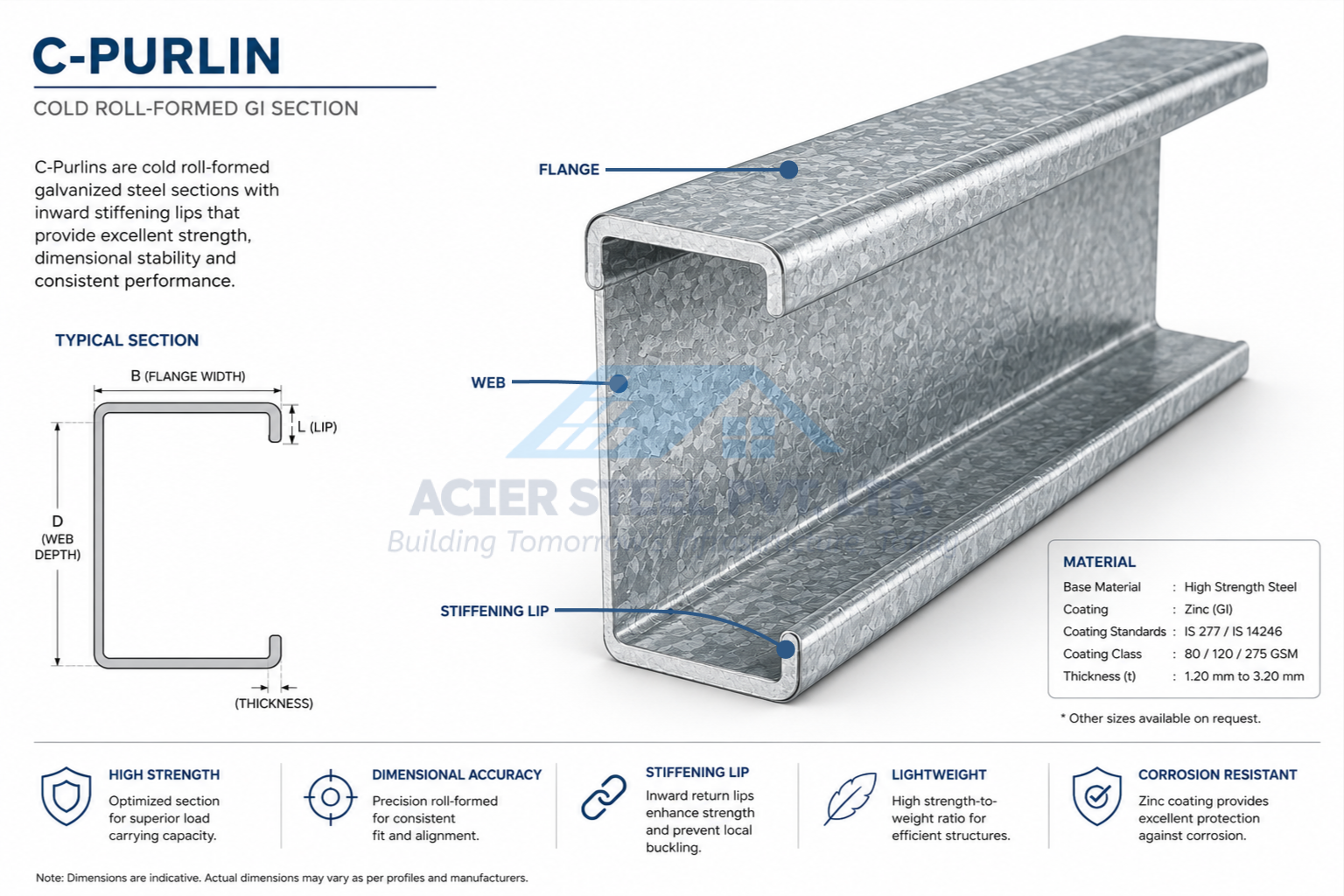
3D Model: Interactive 3D model of Z and C purlins section - drag to inspect
100% Genuine MTC
ISO Certified
Structural Steel
Z & C Purlins - Cold-Formed Structural Sections
Also known as:Steel PurlinsRoof PurlinsCold Formed PurlinsGalvanized Purlins
Cold-formed Z and C purlins for industrial and commercial roof structures. Available in Z120 to Z350 and C100 to C300, galvanized or pre-painted. Fast dispatch across India.
Stock IDZCP-GALV-STD
AvailabilityIn Stock
ManufacturerAcier Steel
Technical Specifications
High-tensile S350 GD / S450 GD steel grade
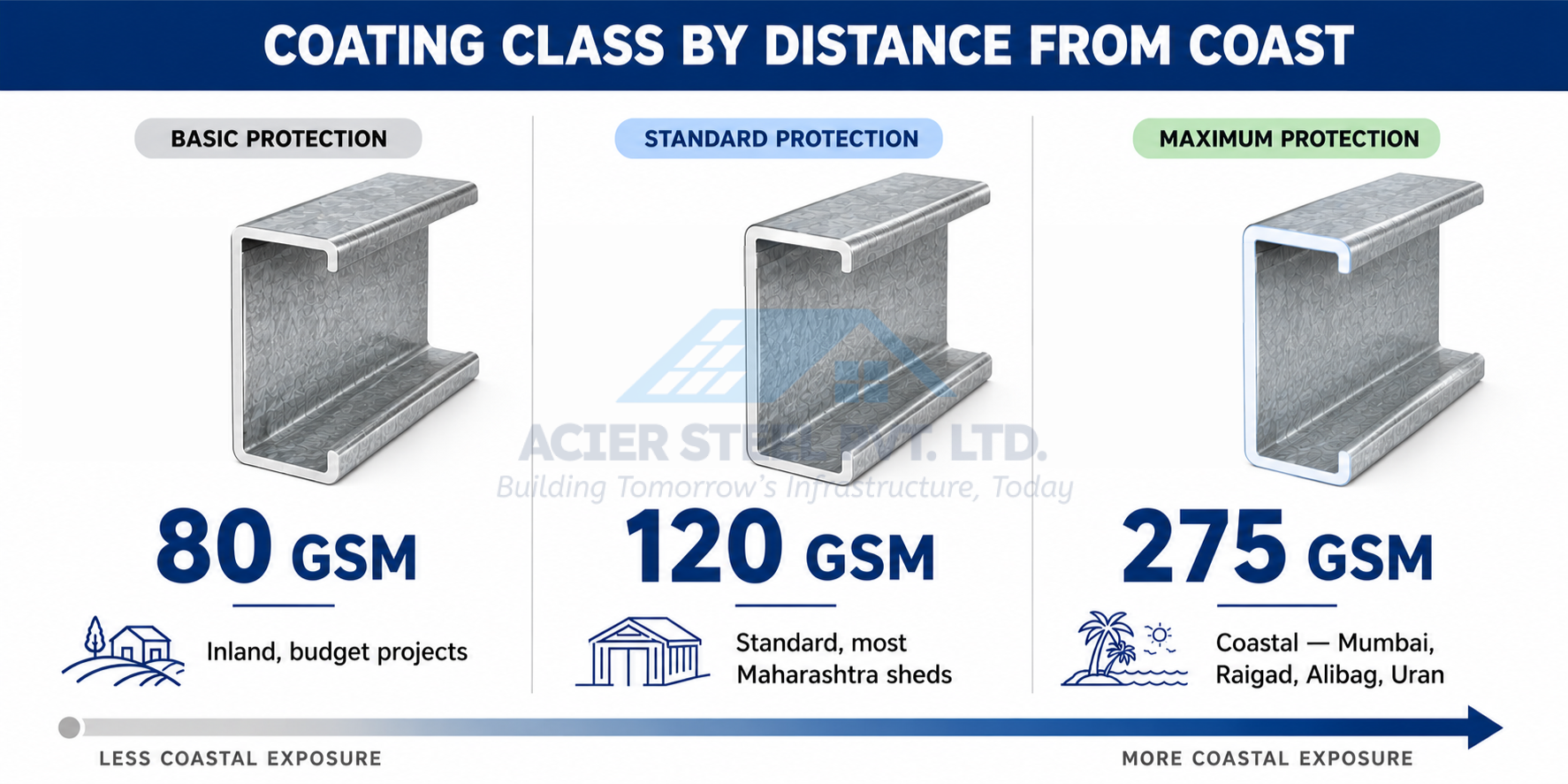
Z275 hot-dip galvanized or pre-painted finish
Z-section: Z120 to Z350 | C-section: C100 to C300
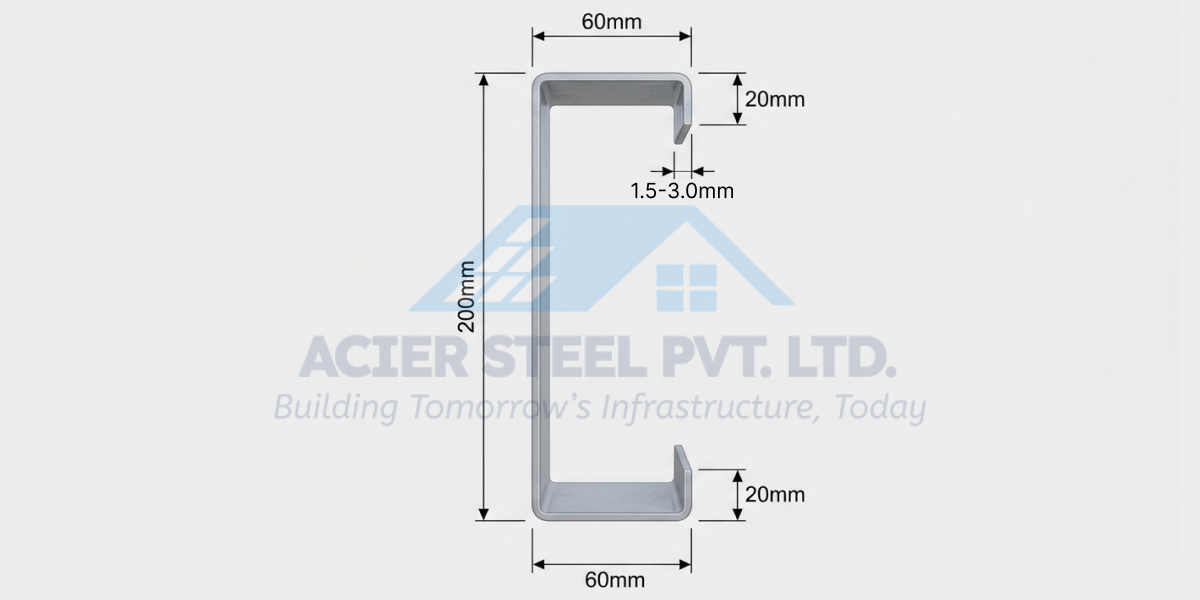
Thickness range: 1.5 mm to 3.0 mm
Pre-punched holes available for faster site fixing
Custom cut lengths with ±2 mm tolerance
Compatible with all standard metal roofing systems
Engineered for 6 m to 12 m rafter bay spacings
Z & C Purlins - Cold-Formed Structural Sections for Roof and Wall Framing
Z and C purlins are the structural backbone of every pre-engineered and portal-frame building. These cold-formed, high-tensile steel sections transfer roof and wall cladding loads to the primary structural frame, delivering a strength-to-weight ratio that hot-rolled angles and channels cannot match at an equivalent cost per linear metre.
When a building envelope demands precise detailing, predictable deflection behaviour, and a finish that survives thirty years of monsoon, industrial atmosphere, and thermal cycling - cold-formed purlins in S350 or S450 grade are the engineered answer.
Z Purlin - Continuous-Span Roof Secondary Steelwork
The Z-section's asymmetric profile is its defining advantage. When adjacent bay Z purlins are lapped over a rafter, they nest into each other, creating a doubled cross-section precisely where bending moments peak at the support. This lap-joint continuity reduces the required section depth and material weight compared to a simply supported design.
Where Z Purlins Are Specified
- Roof secondary steelwork in industrial warehouses, logistics centres, and manufacturing plants
- Continuous-span designs where moment continuity across the rafter line reduces section depth
- Large-bay structures with rafter spacings of 6 m to 12 m
- Long-run roof systems where sheeting laps align with purlin laps for weather-tightness
Z Purlin Lap Design
The lap length is calculated as a proportion of the bay span - typically 10-15 % of span on each side of the rafter. A 7.5 m bay requires a 750 mm to 1 125 mm lap on each side. Pre-punched holes in the web at standard lap lengths allow bolted connections without site drilling, saving two to four minutes per purlin joint on a large roof.
C Purlin - Single-Span and Wall Girt Applications
The symmetric C-section does not nest, eliminating the lap-joint advantage. This is not a limitation - it is a design feature. In locations where lapping is geometrically or structurally inappropriate, the C purlin's symmetry becomes an advantage: it sits flush, fixes cleanly, and carries load without the torsional eccentricity introduced by lapping.
Where C Purlins Are Specified
- End-bay secondary steelwork where only a single purlin spans to the end wall
- Wall girts carrying vertical cladding on all four faces of a building
- Eave purlins, ridge purlins, and verge (barge) members where a single clean profile is required
- Shorter bay spacings up to 7.5 m under lighter-duty loading
- Situations where the roof pitch prevents Z purlin nesting from working correctly
Specification Table
| Parameter | Z Purlin | C Purlin |
|---|---|---|
| Profile range | Z120 - Z350 | C100 - C300 |
| Flange width | 60 - 100 mm | 50 - 90 mm |
| Thickness | 1.5 - 3.0 mm | 1.5 - 3.0 mm |
| Steel grade | S350 GD / S450 GD | S350 GD / S450 GD |
| Coating | Z275 galvanized or pre-painted | Z275 galvanized or pre-painted |
| Standard lengths | 6 m, 7.5 m, 9 m, 12 m | 6 m, 7.5 m, 9 m |
| Custom cut | Yes - ±2 mm | Yes - ±2 mm |
| Pre-punched holes | Available | Available |
| Finish colour (pre-painted) | Goosewing Grey / Merlin Grey | Goosewing Grey / Merlin Grey |
Coating Options and Corrosion Performance
Hot-Dip Galvanized - Z275 Coating
The zinc coating is applied before the coil is roll-formed into a purlin. This means the galvanized layer is continuous across every formed face. At Z275 (275 g/m²), this coating provides a minimum zinc thickness of approximately 19 µm per face - sufficient for a 25-to-40-year service life in rural and semi-industrial atmospheric conditions (ISO corrosivity category C3).
For coastal or heavily industrial environments (C4/C5), specify Z350 coating or add a factory-applied organic top coat. Contact our technical team for corrosivity category mapping of your project location.
Pre-Painted - Polyester or PVDF Finish
Pre-painted purlins are formed from a pre-coated coil. The coating system - primer + topcoat applied by coil-coating before roll-forming - is uniform and factory-controlled. Pre-painted sections are suitable where the internal roof space is visible from within the building and a finished appearance is required without a separate painting contract.
Purlin Schedule - How We Size Your Project
Provide the following information with your inquiry and our structural team prepares a purlin schedule within 24 hours:
- Bay spacing (distance between primary frames in metres)
- Roof pitch (degrees or rise:run)
- Roof dead load (self-weight of sheeting + insulation in kN/m²)
- Design wind speed or wind pressure (from IS 875 Part 3 or your structural engineer's note)
- Eave height and building length
- Site location (for corrosivity category assessment)
The purlin schedule specifies section size, thickness, lap length, bolt size, and pre-punched hole layout - everything the erector needs without ambiguity on site.
Frequently Asked Questions
What is the difference between a Z purlin and a Z girt? The section shape is identical - the terminology changes with orientation. When the same cold-formed Z-section is used horizontally on a wall to support cladding, it is called a girt. When used on a roof to support sheeting, it is called a purlin.
Can Z and C purlins be mixed in the same building? Yes. The standard practice is to use C purlins in end bays (where lapping is not possible) and Z purlins in internal bays (where lapping provides continuity). The section depth and thickness should be matched so that the deflection profile is consistent across all bays.
What self-drilling screw size fixes sheeting to a 2.0 mm purlin? A 5.5 × 32 mm or 5.5 × 38 mm hex head self-drilling screw (point Type 2 or Type 3) drills through the sheeting and into the purlin flange in a single operation. See our Self Drilling Screws page for the full fixing schedule.
Are mill test certificates provided? Yes. Material Test Certificates confirming steel grade (S350/S450), coating weight (Z275), and dimensional conformance to relevant standards are supplied with every delivery.
Available Brand & Specification Options
Detailed pages for specific brand, thickness, and coating combinations.
Interested in Z & C Purlins - Cold-Formed Structural Sections?
Request a custom quote for bulk orders. Full material traceability guaranteed.